Genesis 12: Abram is introduced
Thursday, June 29, 2006
Wednesday, June 28, 2006
Friday, June 23, 2006
Thursday, June 22, 2006
Wednesday, June 21, 2006
Tuesday, June 20, 2006
Monday, June 19, 2006
Genesis 6
Genesis 6
The Flood—Part 1
This seems to indicate that God put a limit on how long a human can live, with the cap being 120 years. Obviously He is not saying that everyone will live exactly 120 years, no more, no less; most people don’t live nearly that long.
Anyway, back to the flood. The entire story is told in chapters 6–8, as follows:
With one important exception, in verse 8: “But Noah found favor in the eyes of the LORD.”
The rest of the chapter reiterates that “the earth was corrupt in God’s sight and was full of violence.” God goes on to explain to Noah what He is going to do—and why He is going to do it—and instruct Noah to build the ark, into which Noah is to bring two of every living creature, male and female. God also gave Noah instructions on how to build the ark; what materials to use, how big it should be, etc. It’s only a few verses, though. (Compare that with instructions for the building of the temple, or the tabernacle, which will take up multiple chapters, in upcoming books!)
On first reading—especially if this is your first time through the Bible, and you’re not familiar with God’s sovereignty—it seems like God was about to wipe out mankind, and then came across Noah, and said “Phew! There’s one good one! Now I don’t have to destroy all of them; I can keep him.” However, we have to keep in mind that God is in control, and there are no “accidents of history”. He orchestrated events such that there would be a Noah, at the right time. He never intended to wipe out all of mankind; what He intended was to give us a lesson in holiness, and in compassion: God is a holy god, and we don’t live up to His holiness. He would be justified in wiping us all out right now, because we deserve it. But He doesn’t, and he didn’t with the flood, because He is patient, and long-suffering.
Modern-day North Americans tend to focus on God’s compassion, and forget about His holiness; for them, the story of the flood is very perplexing. “Why would God wipe out all of mankind?” they ask. “It seems so cruel! That’s not the God I know!” We sometimes have an incomplete picture of God, and only focus on particular attributes. But if your “God” includes the love, and not the holiness, you’re not worshipping the real God. God is loving, but He’s also holy; He is patient and long-suffering, but He’s also just.
The Flood—Part 1
Synopsis
This chapter begins the story of Noah and the flood, but before it does, it contains an interesting little historical footnote, in verses 1–3:When men began to increase in number on the earth and daughters were born to them, the sons of God saw that the daughters of men were beautiful, and they married any of them they chose. Then the LORD said, “My Spirit will not contend with man forever, for he is mortal; his days will be a hundred and twenty years.”
This seems to indicate that God put a limit on how long a human can live, with the cap being 120 years. Obviously He is not saying that everyone will live exactly 120 years, no more, no less; most people don’t live nearly that long.
Anyway, back to the flood. The entire story is told in chapters 6–8, as follows:
- Chapter 6: God’s reasons for the flood
- Chapter 7: The flood happens
- Chapter 8: The waters recede, and Noah comes back out of the ark
The LORD saw how great man’s wickedness on the earth had become, and that every inclination of the thoughts of his heart was only evil all the time. The LORD was grieved that he had made man on the earth, and his heart was filled with pain. So the LORD said, “I will wipe mankind, whom I have created, from the face of the earth—men and animals, and creatures that move along the ground, and birds of the air—for I am grieved that I have made them.”
With one important exception, in verse 8: “But Noah found favor in the eyes of the LORD.”
The rest of the chapter reiterates that “the earth was corrupt in God’s sight and was full of violence.” God goes on to explain to Noah what He is going to do—and why He is going to do it—and instruct Noah to build the ark, into which Noah is to bring two of every living creature, male and female. God also gave Noah instructions on how to build the ark; what materials to use, how big it should be, etc. It’s only a few verses, though. (Compare that with instructions for the building of the temple, or the tabernacle, which will take up multiple chapters, in upcoming books!)
Thoughts
My first thought is about verses 1–3, before the story of the flood: I’m not 100% sure what the Bible means by “the sons of God”. Angels? Doesn’t sound likely. Demons/fallen angels/whatever? Seems more likely to me. In any event, it seems very strange. But I think these verses are put here because they’re an example of how wicked mankind had become. Again, I’m not really sure if that is the case; maybe it’s unrelated to wickedness, and that part of the story only starts in verse 5.On first reading—especially if this is your first time through the Bible, and you’re not familiar with God’s sovereignty—it seems like God was about to wipe out mankind, and then came across Noah, and said “Phew! There’s one good one! Now I don’t have to destroy all of them; I can keep him.” However, we have to keep in mind that God is in control, and there are no “accidents of history”. He orchestrated events such that there would be a Noah, at the right time. He never intended to wipe out all of mankind; what He intended was to give us a lesson in holiness, and in compassion: God is a holy god, and we don’t live up to His holiness. He would be justified in wiping us all out right now, because we deserve it. But He doesn’t, and he didn’t with the flood, because He is patient, and long-suffering.
Modern-day North Americans tend to focus on God’s compassion, and forget about His holiness; for them, the story of the flood is very perplexing. “Why would God wipe out all of mankind?” they ask. “It seems so cruel! That’s not the God I know!” We sometimes have an incomplete picture of God, and only focus on particular attributes. But if your “God” includes the love, and not the holiness, you’re not worshipping the real God. God is loving, but He’s also holy; He is patient and long-suffering, but He’s also just.
Wednesday, June 14, 2006
Genesis 5
Genesis 5
Genealogy
People get very focused on how long people lived in Genesis, so here are the men listed in this chapter, and the age at which they died:
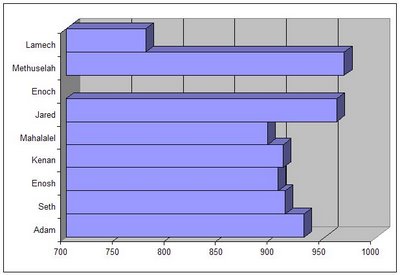
I’m not sure the significance of the fact that God took Enoch away, instead of allowing him to die like everyone else. I do know that he is mentioned a couple of times in the New Testament:
and
You may do with that information what you will.
Genealogy
Synopsis
This chapter records Adam’s descendants, up to Noah. It lists the name of the father, how old he was when he had his first child, and then at what age he died. It then goes on to the next in line, which, I assume, is probably the eldest boy—except for Seth, Adam’s son, who would have been Cain and Abel’s younger brother, I think. But of course Abel was dead, and Cain had been banished.People get very focused on how long people lived in Genesis, so here are the men listed in this chapter, and the age at which they died:
- Adam: 930
- Seth: 912
- Enosh: 905
- Kenan: 910
- Mahalalel: 895
- Jared: 962
- Enoch: no age listed; verse 24 says “Enoch walked with God; then he was no more, because God took him away.”
- Methuselah: 969
- Lamech: 777
Thoughts
One interesting item is that the chapter lists Methuselah; his name has become synonymous with old age, because he lived the longest of anyone in this chapter. Not much longer, comparatively, but still, the longest.
I’m not sure the significance of the fact that God took Enoch away, instead of allowing him to die like everyone else. I do know that he is mentioned a couple of times in the New Testament:
By faith Enoch was taken from this life, so that he did not experience death; he could not be found, because God had taken him away. For before he was taken, he was commended as one who pleased God. (Hebrews 11:5)
and
Enoch, the seventh from Adam, prophesied about these men: “See, the Lord is coming with thousands upon thousands of his holy ones to judge everyone, and to convict all the ungodly of all the ungodly acts they have done in the ungodly way, and of all the harsh words ungodly sinners have spoken against him.” (Jude 14–15)
You may do with that information what you will.
Tuesday, June 13, 2006
Genesis 4
Genesis 4: Cain and Abel—the first murder
Eventually both sons brought offerings to the LORD; Cain brought some of the fruits of the soil, and Abel brought fat portions from some of the firstborn of his flock. Which makes sense, since that’s what each did for a living. But the LORD “looked with favour on Abel and his offering, but on Cain and his offering he did not look with favour.” (verses 4–5)
This made Cain angry, so he lured his brother out into the field, and killed him. And then, in verse 9, God again asks questions that He already knows the answers to:
Ouch. I’m thinking it might not be a good idea to mouth off to the LORD of all creation, but that’s just me.
Cain’s punishment is that the ground will no longer yield its crops for him, and that God’s presence will be hidden from him. Cain will become a “restless wanderer” (verse 12). Cain is afraid that he will be killed, since he no longer has God’s protection, so God puts a mark on Cain “so that no one who found him would kill him” (verse 15).
The rest of the chapter, from verse 17 on, is simply some extra genealogy, of Cain’s children, and some more of Adam and Eve’s children.
This chapter is where we get the concept of the “mark of Cain” that people sometimes refer to, in slightly different ways. In the Bible, according to the text, the mark was simply used to indicate to others that Cain must not be killed. In verse 15 God says that “if anyone kills Cain, he will suffer vengeance seven times over.”
Finally, keep in mind, when reading some of these chapters in Genesis, that the Bible doesn’t record every single son and daughter who were born. It’s clear, from Cain’s fear of being killed, that there are already a number of people in the world, by this time, not just Adam, Eve, and Cain.
Synopsis
Adam and Eve, of course, bore children, and the first two children were Cain and Abel. When they grew up, “Abel kept flocks, and Cain worked the soil” (verse 2b).Eventually both sons brought offerings to the LORD; Cain brought some of the fruits of the soil, and Abel brought fat portions from some of the firstborn of his flock. Which makes sense, since that’s what each did for a living. But the LORD “looked with favour on Abel and his offering, but on Cain and his offering he did not look with favour.” (verses 4–5)
This made Cain angry, so he lured his brother out into the field, and killed him. And then, in verse 9, God again asks questions that He already knows the answers to:
Then the LORD said to Cain, “Where is your brother Abel?”
“I don’t know,” he replied. “Am I my brother’s keeper?”
Ouch. I’m thinking it might not be a good idea to mouth off to the LORD of all creation, but that’s just me.
Cain’s punishment is that the ground will no longer yield its crops for him, and that God’s presence will be hidden from him. Cain will become a “restless wanderer” (verse 12). Cain is afraid that he will be killed, since he no longer has God’s protection, so God puts a mark on Cain “so that no one who found him would kill him” (verse 15).
The rest of the chapter, from verse 17 on, is simply some extra genealogy, of Cain’s children, and some more of Adam and Eve’s children.
Thoughts
First off is the question of why the LORD accepted Abel’s offering, and not Cain’s. The most common answer—and, probably, the one that is correct—is that Abel’s sacrifice was a blood sacrifice, and Cain’s was not. And the only thing that bugs me about that idea is that grain offerings were acceptable by God, when He set out the laws for the Israelites later on. I would guess that it’s the type of offering being offered; grain offerings are probably acceptable for some things, and blood sacrifices for other things. For example, if they were giving the offerings as a sin offering, then it would have to be a blood offering. But I’m not an expert on the sacrificial system. However, despite the specifics, I think the main point is that Abel’s sacrifice cost him more than Cain’s sacrifice cost him. It’s called a “sacrifice” for a reason—the idea is that you are putting God, and God’s needs and desires, above your own. If you don’t give Him the best, because you want to keep it for yourself, then you haven’t really sacrificed at all.This chapter is where we get the concept of the “mark of Cain” that people sometimes refer to, in slightly different ways. In the Bible, according to the text, the mark was simply used to indicate to others that Cain must not be killed. In verse 15 God says that “if anyone kills Cain, he will suffer vengeance seven times over.”
Finally, keep in mind, when reading some of these chapters in Genesis, that the Bible doesn’t record every single son and daughter who were born. It’s clear, from Cain’s fear of being killed, that there are already a number of people in the world, by this time, not just Adam, Eve, and Cain.
Minor Change—Non Bible Related
Not that it’s too important, but I’ve gone back and removed the links from all of the titles of these posts, since they were causing problems. Instead, I’m making the first line of each post a link to the relevant chapter/passage on Bible Gateway.
I wouldn’t even have bothered to mention it, except that I’m one of those people who doesn’t like to change a post once it’s up—no matter how tempting it might be.
I wouldn’t even have bothered to mention it, except that I’m one of those people who doesn’t like to change a post once it’s up—no matter how tempting it might be.
Subscribe to:
Posts (Atom)